

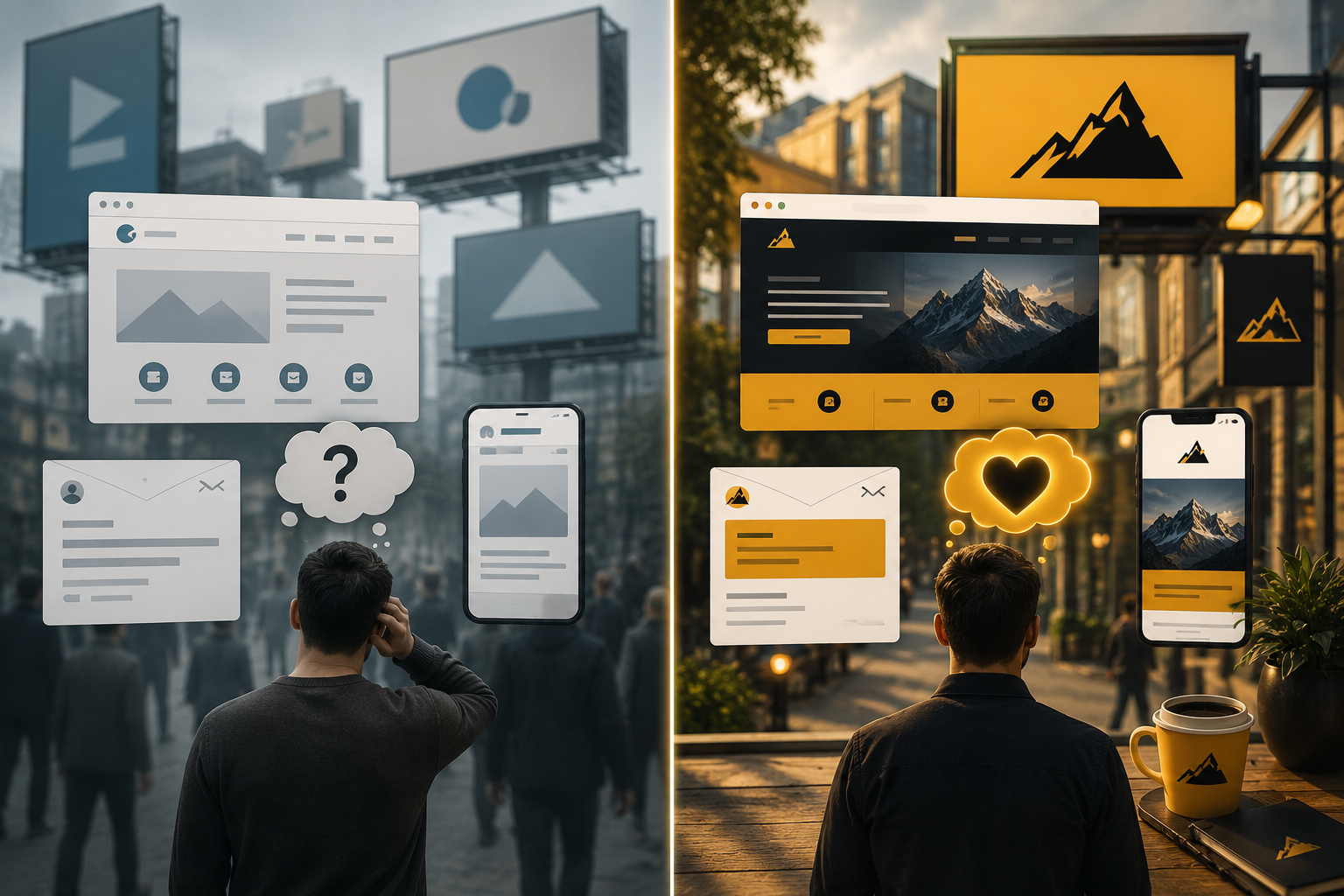
How to Build a Brand That People Actually Remember
Here's an uncomfortable test. Cover your logo and read your own homepage. Could that page belong to any other company in your category? If the honest answer is yes, you don't have a weak brand. You have an invisible one — and invisible is worse than disliked, because at least people remember what they dislike.
Being remembered isn't a byproduct of being good at what you do. Plenty of excellent businesses are completely forgettable, and plenty of average ones are stuck in people's heads for a decade. Memory doesn't reward quality. It rewards distinctiveness, repeated consistently, over time. That's the entire game, and most brand strategy misses it by chasing "differentiation" — being better — when the actual lever is "distinctiveness" — being unmistakable.
Distinctive beats different
This is the finding that built an entire field of marketing science, and most small businesses have never heard of it: people rarely remember why a brand is better. They remember what a brand looks and sounds like. A specific color. A specific shape. A phrase said the exact same way every time. Researchers call these distinctive brand assets, and decades of study on how memory actually works say they're more powerful at building recall than any list of features or benefits ever will be.
That's genuinely good news for a small business, because it means you don't need a bigger differentiation story than your competitors. You need a smaller number of specific, ownable signals — repeated so consistently that they become shortcuts back to you in someone's memory, whether or not they could ever explain what makes you "better."
The most expensive brand mistake: having a brand book nobody follows
Almost every company we meet already has a brand guide. Colors, fonts, logo usage — all documented, all sitting in a shared drive that hasn't been opened since the designer sent the invoice. This is the branding equivalent of buying gym equipment and using it as a coat rack. The guide isn't the brand. The repetition is the brand. A distinctive color used inconsistently isn't a distinctive asset — it's just a color you happened to use once.
Figures are drawn from widely cited marketing and cognitive-psychology research, cited directionally to show the shape of the effect rather than a guarantee for any specific brand.
Nobody falls in love with a brand at first sight. They fall in love with a brand they've seen the same way a dozen times without noticing they were being convinced.
What actually makes a brand stick
- One color, used relentlessly. Not a palette of eight options picked case by case — a signature color that becomes shorthand for you before anyone reads a word.
- A voice with an actual opinion. Bland is safe and bland is invisible. Say something a competitor in your category wouldn't say, consistently, and people start to recognize the way you talk before they recognize your logo.
- One idea, repeated, not ten ideas said once. Pick the single thing you want to be known for and say it the same way across your website, your emails, and your social posts until it feels repetitive to you — that's usually the point it starts working on everyone else.
- A signature detail people can describe to a friend. A phrase, a sound, a visual quirk — something specific enough that someone could describe it to another person and have them recognize you.
- Patience. Distinctive assets take years of consistent repetition to build. The brands that feel iconic didn't get there by being clever once. They got there by refusing to change the thing that was working.
What quietly kills brand memory
- Rebranding every two to three years because the old look "feels dated" — resetting the recognition clock right before it was about to pay off.
- Using a different tone on Instagram, in emails, and on the website, so nothing ever feels like it came from the same company twice.
- Chasing whatever visual trend is popular this year instead of committing to something ownable for the long term.
- Trying to appeal to everyone, which produces a brand with no edges — and nothing without edges is memorable.
The bottom line
You don't need a bigger budget than your competitors to be remembered better than them. You need fewer, more consistent signals, repeated for longer than feels comfortable. Most businesses give up on their visual identity and voice right around the point it was about to become distinctive, because repetition feels boring from the inside. It doesn't feel boring from the outside — it feels like finally recognizing someone.
Not sure if your brand is distinctive or just decorated?
MindActive will tell you honestly which one you've built.

What Is Brand Positioning and Why It Matters More Than Ever
In today’s market, being good is no longer enough. There are thousands of businesses offering simi

Why Most Brands Fail to Stand Out And How to Fix It
Being good is not enough anymore Most brands are not failing because their products are bad. They ar