

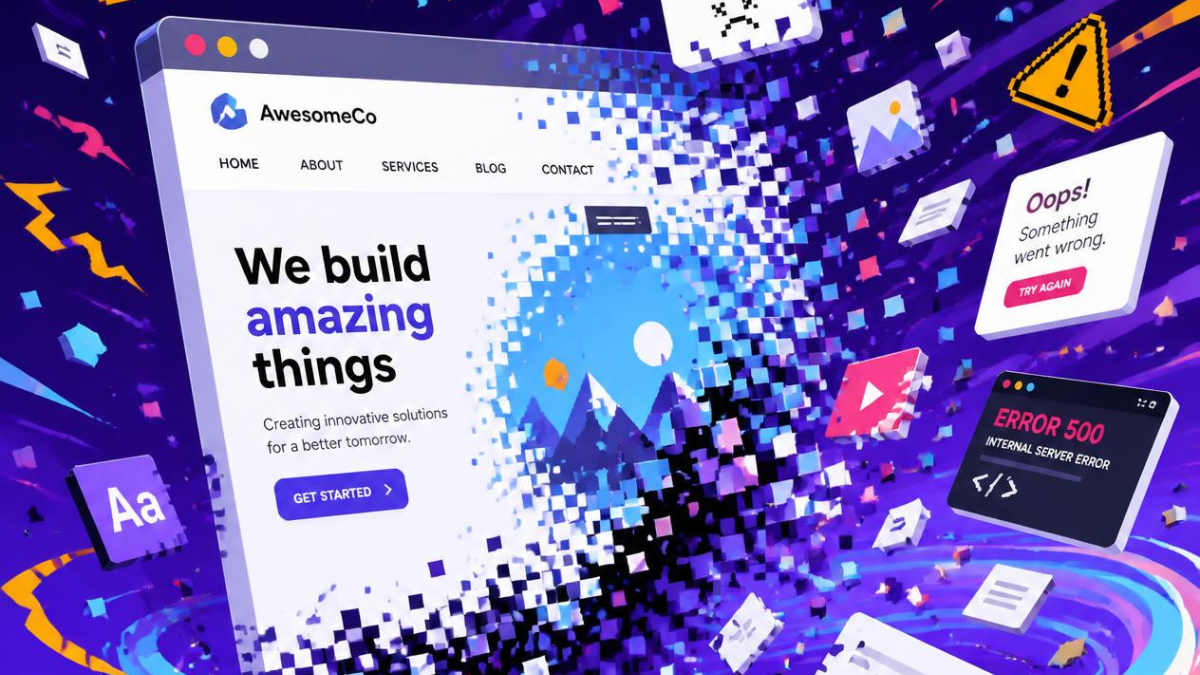
Why Most Business Websites Fail (And How to Fix Yours)

Your website isn't failing because it looks outdated.
It’s failing because it isn’t doing its job.
Every day, business owners invest in:
- beautiful designs
- premium templates
- expensive developers
- modern animations
Yet months later, they’re still asking:
“Why aren’t we getting more leads?”
The problem usually isn’t traffic.
It isn’t your logo.
It isn’t even your website design.
It’s that your website was built to exist, not to convert.
A successful website doesn’t just look professional.
It guides visitors toward becoming customers.
If yours isn’t doing that, it’s costing you opportunities every single day.
The Real Purpose of a Business Website
Many businesses still think of their website as an online brochure.
Something that says:
- who they are
- what they do
- how to contact them
But today’s buyers expect much more.
Your website should:
- attract qualified visitors
- build trust
- answer questions
- reduce uncertainty
- guide users toward action
In other words, your website should function as your best salesperson.
If it isn’t generating leads consistently, it’s underperforming.
Mistake #1: Your Value Proposition Isn't Clear
When someone lands on your homepage, they should immediately understand:
- What do you do?
- Who do you help?
- Why should they choose you?
If visitors have to scroll or guess, you’ve already lost attention.
According to Nielsen Norman Group, users decide within seconds whether a website feels relevant to them.
Instead of saying:
“We provide innovative digital solutions.”
Try saying:
“We help service businesses generate more qualified leads through high-converting websites, strategic branding, and AI-powered systems.”
Clarity beats cleverness every time.
Mistake #2: You're Talking About Yourself Instead of Your Customer
Many websites start with:
“We’ve been in business for 15 years…”
Or:
“We’re passionate about helping clients…”
Your visitors aren’t asking about you.
They’re asking:
- Can you solve my problem?
- Can I trust you?
- What happens if I work with you?
Position your customer as the hero.
Your business is simply the guide.
Mistake #3: Weak Calls-to-Action
Many websites end every page with:
“Contact Us.”
But why?
A strong call-to-action tells visitors exactly what they’ll gain.
Examples include:
- Book a Free Strategy Call
- Request a Website Audit
- Download the Guide
- Get Your Free Estimate
- See What’s Holding Your Website Back
Every page should have one primary goal.
Don’t leave visitors wondering what to do next.
Mistake #4: No Trust Signals
People don’t buy because you say you’re great.
They buy because they believe you.
Trust can be built through:
- client testimonials
- Google reviews
- case studies
- before-and-after examples
- certifications
- recognizable client logos
According to BrightLocal, 98% of consumers read online reviews before choosing a local business.
Source:
https://www.brightlocal.com/research/local-consumer-review-survey/
If your website lacks proof, visitors have little reason to trust you.
Mistake #5: Slow Website Performance
Patience online is short.
According to Google, as page load time increases from one second to three seconds, the probability of a visitor leaving increases dramatically.
Source:
https://web.dev/articles/why-speed-matters
A slow website creates:
- frustration
- lower SEO rankings
- abandoned sessions
- lost sales
Speed is no longer a luxury.
It’s part of the user experience.
Mistake #6: Poor Mobile Experience
More than half of all web traffic comes from mobile devices.
Yet many business websites still feel like desktop websites squeezed onto a phone.
Mobile visitors expect:
- fast loading
- easy navigation
- readable text
- simple forms
- large buttons
If your website frustrates mobile users, you’re likely losing customers before they ever contact you.
Mistake #7: Generic Messaging
Many businesses sound exactly alike.
They all claim to offer:
- quality service
- excellent customer support
- innovative solutions
- trusted expertise
None of these statements differentiate your business.
Instead, communicate outcomes.
Instead of:
“We build websites.”
Say:
“We build websites that consistently turn visitors into qualified leads.”
Specific messaging creates stronger positioning.
Mistake #8: No SEO Strategy
A beautiful website doesn’t matter if nobody finds it.
Search engine optimization helps your business appear when potential customers search for solutions.
Strong SEO includes:
- keyword-focused content
- optimized page titles
- fast performance
- internal linking
- high-quality blog content
Businesses that invest in SEO build long-term visibility instead of relying entirely on paid advertising.
Mistake #9: No Content Strategy
Many websites remain unchanged for years.
That sends the wrong signal to both visitors and search engines.
Regular content helps:
- improve rankings
- answer customer questions
- establish authority
- generate organic traffic
Blogs, videos, guides, and case studies all contribute to a stronger digital presence.
Content builds trust long before someone contacts your business.
Mistake #10: Your Website Isn't Part of a Larger Business System
Your website shouldn’t operate in isolation.
It should connect with:
- your branding
- your content marketing
- your videos
- your CRM
- your AI workflows
- your email automation
When these systems work together, your website becomes much more than a marketing asset.
It becomes a growth engine.
How to Fix Your Website
Improving your website doesn’t always require a complete redesign.
Start by asking these questions:
Is my value proposition clear?
Can someone understand what you do within five seconds?
Does every page guide users toward action?
If not, strengthen your calls-to-action.
Does the website build trust?
Add testimonials, case studies, and proof.
Is the experience fast and mobile-friendly?
Test performance regularly.
.
Is my content answering customer questions?
Educational content builds authority and improves SEO.
.
Is my website connected to my overall marketing strategy?
Your website should support your entire customer journey.
.
The Businesses Winning Online Think Differently
Successful businesses no longer view their website as a project.
They view it as a business system.
Their website works alongside:
- branding
- SEO
- AI
- video
- content marketing
- lead generation
Everything supports everything else.
That’s what creates consistent growth.
The Bottom Line
Most business websites don’t fail because they’re ugly.
They fail because they’re unclear.
They don’t communicate value quickly.
They don’t build trust effectively.
They don’t guide visitors toward action.
And they aren’t connected to a larger growth strategy.
Fortunately, every one of those problems can be fixed.
Sometimes with targeted optimization.
Sometimes with a complete rebuild.
The key is identifying what’s actually holding your website back.
Because your website should be your hardest-working employee.
Not your biggest missed opportunity.
Ready to Find Out What's Holding Your Website Back?
At MindActive, we help businesses transform underperforming websites into high-converting digital assets.
Whether your website needs strategic optimization or a complete rebuild, we’ll help you identify the smartest path forward based on your business goals—not assumptions.
References & Sources
- Nielsen Norman Group – Value Proposition Research
https://www.nngroup.com/articles/value-proposition/ - BrightLocal Consumer Review Survey
https://www.brightlocal.com/research/local-consumer-review-survey/ - Google Web Performance Research
https://web.dev/articles/why-speed-matters - HubSpot Website Design Statistics
https://blog.hubspot.com/marketing/website-design-statistics - Google Search Central SEO Documentation
https://developers.google.com/search
Should You Rebuild Your Website or Optimize It?
Before you spend thousands on a new website, ask yourself one question. Is your website actually the
The 7 Elements of a High-Converting Website in 2026
1. Immediate clarity (Above-the-fold matters most) Users should instantly understand: Because if the
The Complete Guide to Optimizing Your Website for Conversions
Understanding Website Conversions A website conversion happens when a visitor takes a desired action