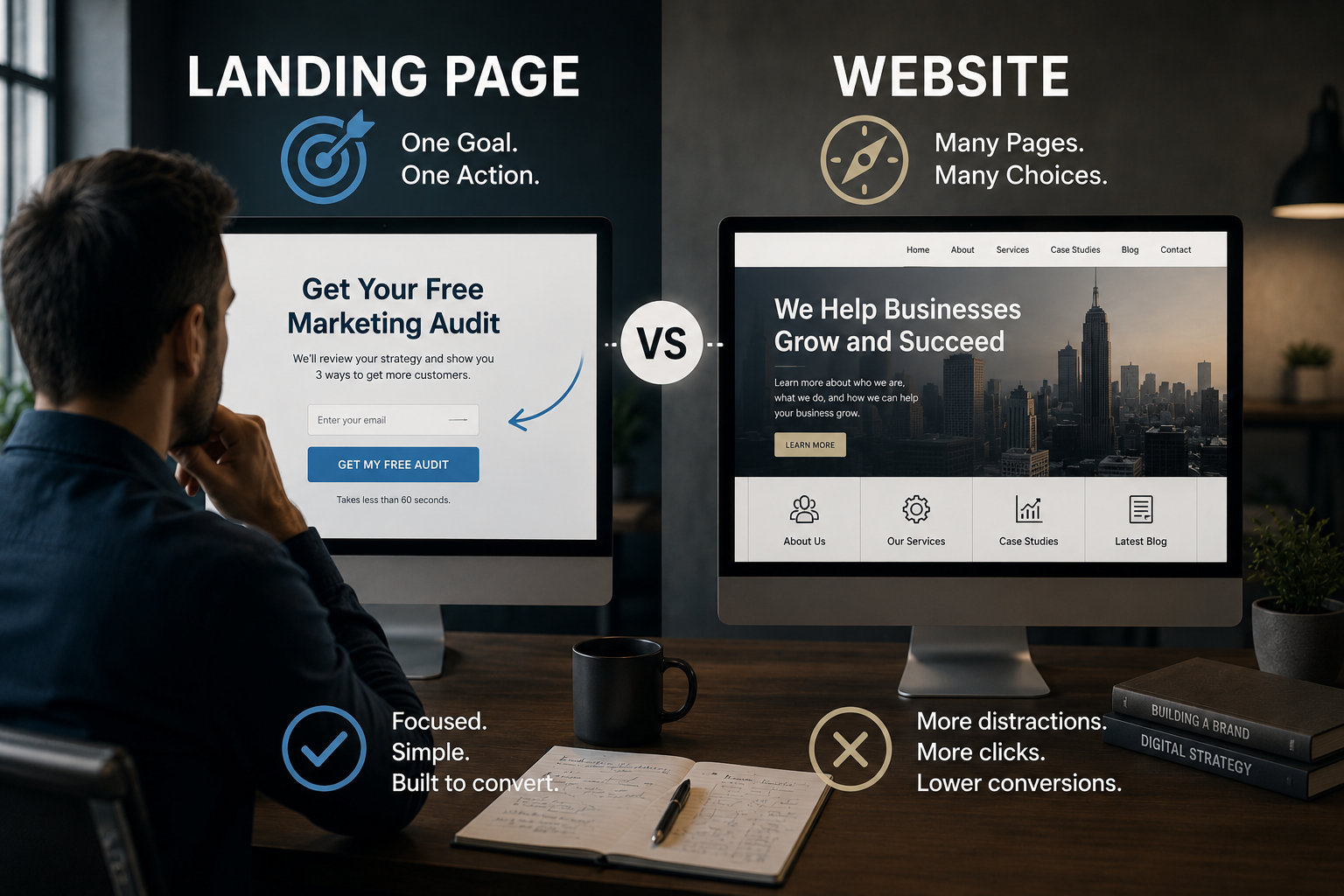
"We need a website" is the most expensive assumption in small business marketing. Sometimes it's true. Just as often, what the business actually needs is one focused page that does one job — and the "website" they commission instead quietly buries that job under a navigation menu, four other pages, and a mission statement nobody asked for.
These aren't two versions of the same thing. They're built for opposite jobs. A website's job is to hold everything about your business and let a visitor explore. A landing page's job is to get one visitor to do one thing, with every distraction removed. Confuse the two and you pay for it twice — once in the build, and again in the conversion rate.
The core difference, in plain terms
A website is a destination. Someone arrives already curious about you, and your job is to answer whatever question they showed up with — who you are, what you offer, whether they can trust you. It has a navigation menu because it expects to be explored.
A landing page is a doorway. Someone arrives from one specific place — an ad, an email, a LinkedIn post — already primed for one specific offer. It has no navigation, often no exit, because every other path is a way for that visitor to leave without converting. That's not a limitation. That's the entire design strategy.
PurposeTell the full story of your business, ongoing.
PurposeGet one visitor to take one specific action.
StructureMultiple pages, full navigation, encourages exploring.
StructureSingle page, minimal or no nav, one path forward.
Best forSEO, credibility, being found, being researched.
Best forAd campaigns, lead magnets, launches, promotions.
LifespanLong-term, evergreen, rarely rebuilt from scratch.
LifespanOften short-term, built and retired per campaign.
Success metricTime on site, pages per visit, return visits.
Success metricConversion rate. One number, no ambiguity.
When you actually need a website
You need a website when people are going to look for you — not just click an ad and land somewhere. If you're relying on search, referrals, or someone typing your name into Google after hearing about you at a networking event, you need a home base that can answer whatever question they bring with them. That's a website's job, and a landing page can't do it — it wasn't built to.
When you actually need a landing page
You need a landing page when you're sending traffic from one specific source to one specific offer — a LinkedIn post, a paid ad, an email campaign, a lead magnet. The moment you're paying for a click or asking for someone's attention on a specific promise, that promise deserves its own page, not a slot on your homepage competing with six other messages.
4.02% vs 2.35%Median conversion rate for a dedicated landing page versus a general website page — nearly double (Unbounce 2026 Conversion Benchmark Report, 44M conversions analyzed).
11.45%+What the top quartile of landing pages convert at. The gap from the median is rarely about traffic — it's focus, form length, and message match.
160%How much better a dedicated landing page converts compared to a generic signup box or embedded form.
55%More leads generated by businesses running 10–15 landing pages compared to fewer than 10 (HubSpot).
~7%Conversion lost for every additional second of page load time — true for both websites and landing pages, but it costs more on a page you're already paying to send traffic to.
77%Estimated share of pages businesses call their "landing page" that are actually just their homepage with a different headline — no dedicated funnel behind it.
Figures are drawn from published 2025–2026 industry research (Unbounce, HubSpot, and related benchmarking studies), cited directionally to show the shape of the trend rather than a guarantee for any specific business.
A website answers a question. A landing page asks one. Building the wrong one means you're either giving unasked-for answers or asking a question no one's ready to hear.
Signs you built the wrong one
- Your ad traffic lands on your homepage, and visitors have to hunt through a nav menu to find the offer they clicked for.
- Your "landing page" has a header, a footer, and six other links pulling attention away from the one action you wanted.
- You built a five-page website for a single product launch that will be irrelevant in three months.
- You're tracking "sessions" on a page that exists to do exactly one job — and you still can't say what your conversion rate is.
What smart businesses actually do
- They keep one strong website as the home base — the place that earns trust, ranks in search, and answers the general "who are you" question.
- They spin up a dedicated landing page for every campaign, every lead magnet, every specific offer — built to convert, retired when the campaign ends.
- They never send paid or campaign traffic to the homepage. Every dollar spent on attention lands on a page built for the exact promise that earned the click.
- They measure the two differently — brand and findability for the website, conversion rate for the landing page — instead of judging both by the same number.
The bottom line
This isn't an either/or decision. Most businesses that are actually growing have both, doing different jobs on purpose. The mistake isn't picking the wrong one — it's not realizing there was a choice to make, and asking one page to do both jobs badly instead of two pages to do one job each, well.
Not sure which one your next campaign actually needs?
MindActive builds both — and tells you honestly which one solves your problem.
Start the Conversation