

How AI Is Changing the Way Businesses Operate in 2026

For the last couple of years, AI in most businesses meant one thing: someone on the team using a chatbot to draft emails or summarize a document. Useful, but peripheral — a tool sitting next to the actual work, not part of it.

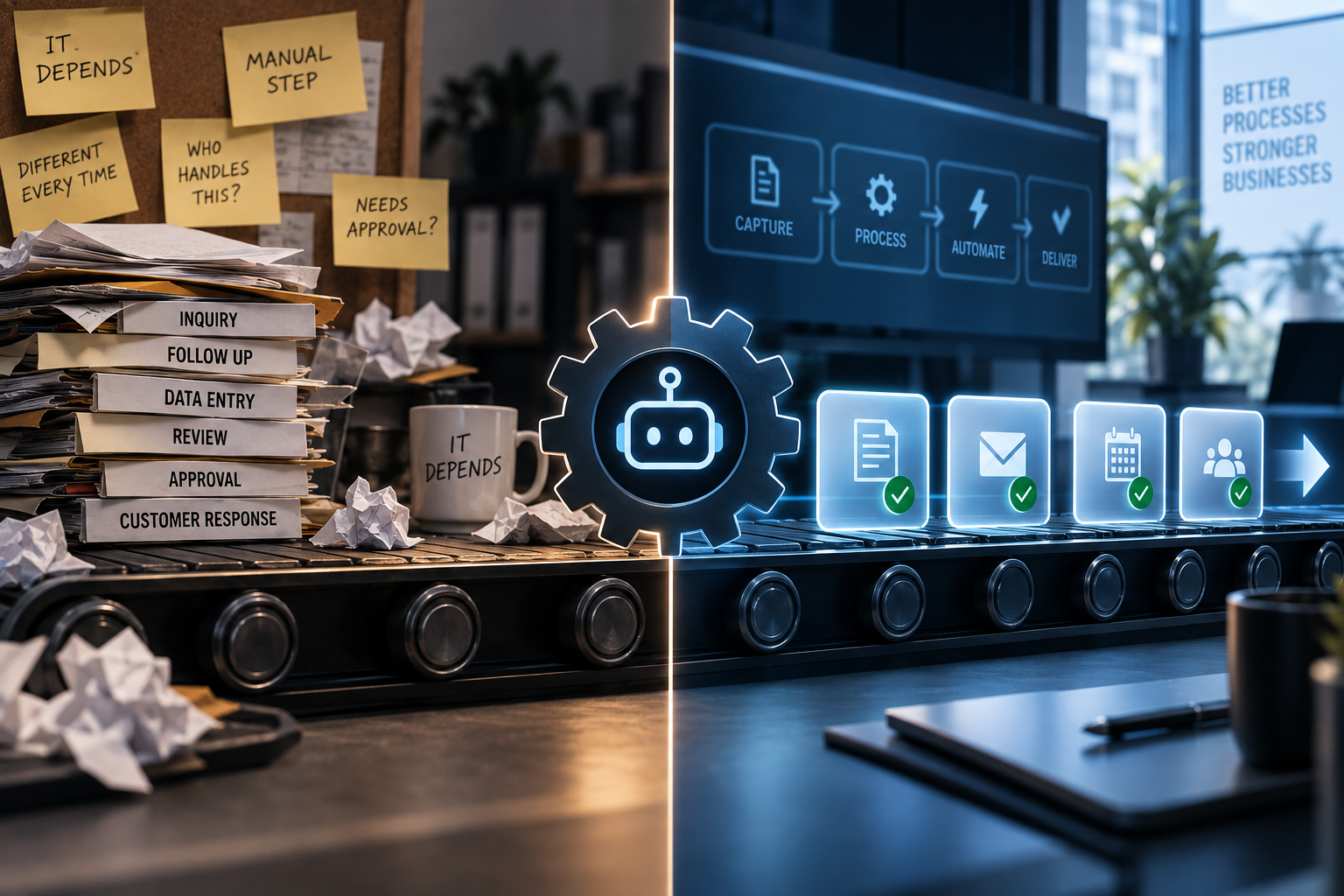
That’s no longer where things stand. Heading through 2026, AI has moved from a side experiment to something closer to infrastructure — quietly present in how leads get followed up on, how inventory gets forecasted, how reports get built, and how decisions get made. The businesses feeling the difference aren’t the ones with the flashiest tools. They’re the ones that changed how work actually flows.

Here’s what that shift looks like in practice.

AI Stopped Being a Side Project

The first wave of AI adoption looked like a lot of small, disconnected experiments — one team piloting a chatbot, another testing an image tool, nobody quite sure if any of it was working. That phase is winding down. According to PwC’s 2026 AI predictions, more companies are now running AI as a coordinated, top-down effort instead of scattered pilots — leadership picks a handful of workflows where the payoff is real, then commits the team, the tools, and the process changes to make it stick.

You don’t need an enterprise budget to apply the same logic. The businesses getting real value aren’t the ones with the most AI tools installed — they’re the ones that picked one or two workflows that actually matter and rebuilt them properly. We wrote about what that rebuild looks like in practice in AI Workflows: How to Automate Your Business Without Breaking It — the short version is that automation needs a clear target and a checkpoint, not just a new subscription.

Decisions Are Getting Faster, Not Just More Automated

The bigger shift isn’t automation for its own sake — it’s what happens to decision-making when data stops sitting in a monthly report and starts feeding a live model. Instead of finding out demand shifted last quarter, businesses are starting to see it shift this week. That changes the rhythm of the whole operation: pricing, staffing, inventory, and outreach can all respond to what’s actually happening instead of what happened a month ago.

This is also where AI agents come in — systems that can carry out a multi-step task on their own instead of just answering a question. A well-set-up agent can pull a lead’s information, draft the follow-up, and flag it for review, instead of a person doing each step by hand. The tools have gotten genuinely capable here. The part that still separates a working system from a broken one is the same guardrail we’ve mentioned before — a human checkpoint on anything that touches a customer, until the pattern has earned enough trust to run on its own.

What This Actually Looks Like for Small and Mid-Size Businesses

Enterprise AI headlines can make this feel like a big-company story, but the data says otherwise. A recent report from the U.S. Chamber of Commerce, drawing on LinkedIn data across millions of small businesses, found that most small businesses are already using AI in some form — and the ones seeing real gains treat it as a skill their team is building, not a tool they bought once and forgot. AI literacy is turning into a genuine differentiator, on top of the tools themselves.

The same research made a point worth sitting with: even as AI takes on more of the repetitive work, small business owners still say relationships — with customers, referral networks, their own communities — are what actually drive growth. AI is freeing up the hours. It isn’t replacing the trust-building. That combination is exactly the gap we built AI Class Lab to close — helping teams turn scattered AI experiments into something that’s actually part of how they work day to day, instead of one more tab they forgot was open.

Governance Is No Longer Optional

As AI takes on more actual decision-making — not just drafting text, but approving, flagging, and routing — the question of who’s accountable for what it does stops being theoretical. Which tasks can a system handle without a human sign-off? What data is it allowed to touch? Who’s responsible if it gets something wrong? Businesses that answer these questions in writing, before they need to, are in a much better position than the ones figuring it out after something breaks.

That’s the whole premise behind the AI Governance Document Service — a straightforward policy and staff rulebook that gives a business’s AI use actual guardrails, without turning it into a legal project.

The Businesses Pulling Ahead Aren't Doing More — They're Doing It on Purpose

None of this requires chasing every new release or rebuilding the business overnight. The pattern across the research is consistent: the organizations seeing real results picked a small number of workflows that mattered, built them carefully, and gave their people the skills to keep improving them.

If you’re trying to figure out where your business actually stands on that path, that’s the exact question Spark AI Strategy, MindActive’s AI partner, is built to help answer — not by selling you more tools, but by getting clear on what’s worth building first.