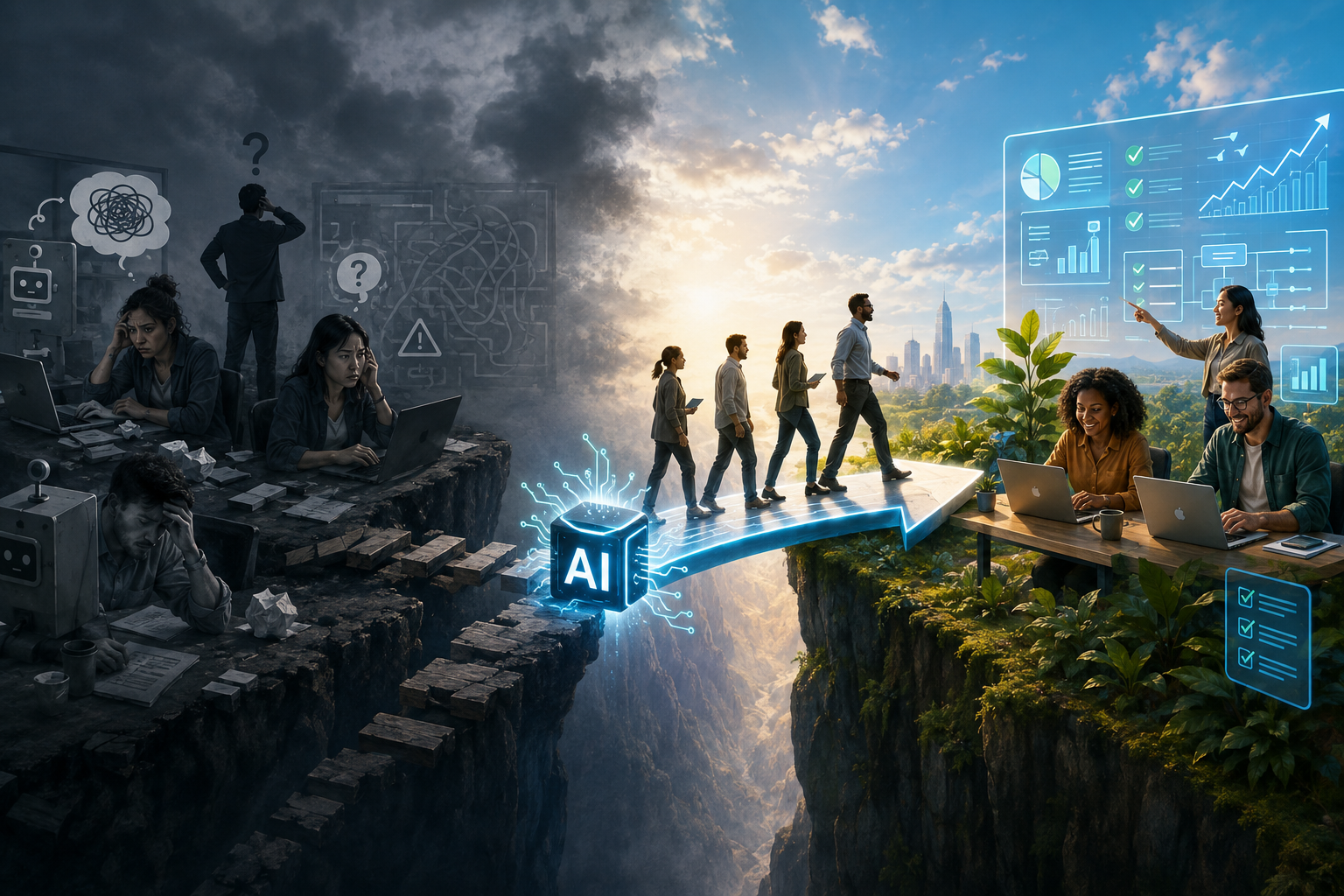
Your team already has AI. That part's done — 86% of individual contributors and 93% of managers are already using it at work. What almost nobody has is the skill to use it well, and that gap is quietly becoming the biggest performance difference between companies that look identical on paper.
Here's the number that should worry you more than any of the adoption stats: only 24% of individual contributors and 77% of managers strongly agree their organization actually prepared them to use AI effectively. Everyone got the tool. Almost nobody got the training. That mismatch has a name — the AI skill gap — and it's not closing on its own.
This isn't a smart-people problem. It's an organizational one.
The instinct is to assume the gap is about aptitude — some people are just naturally better with AI tools, and everyone else will catch up eventually. Microsoft's 2026 Work Trend Index says otherwise: when they broke down what actually predicts good AI outcomes, culture, manager support, and talent practices explained 67% of the result. Individual skill or aptitude explained only 32%. In plain terms — the gap isn't in your people. It's in whether anyone ever built a system for them to get good at this.
Untrained AI Use
Skilled AI Use
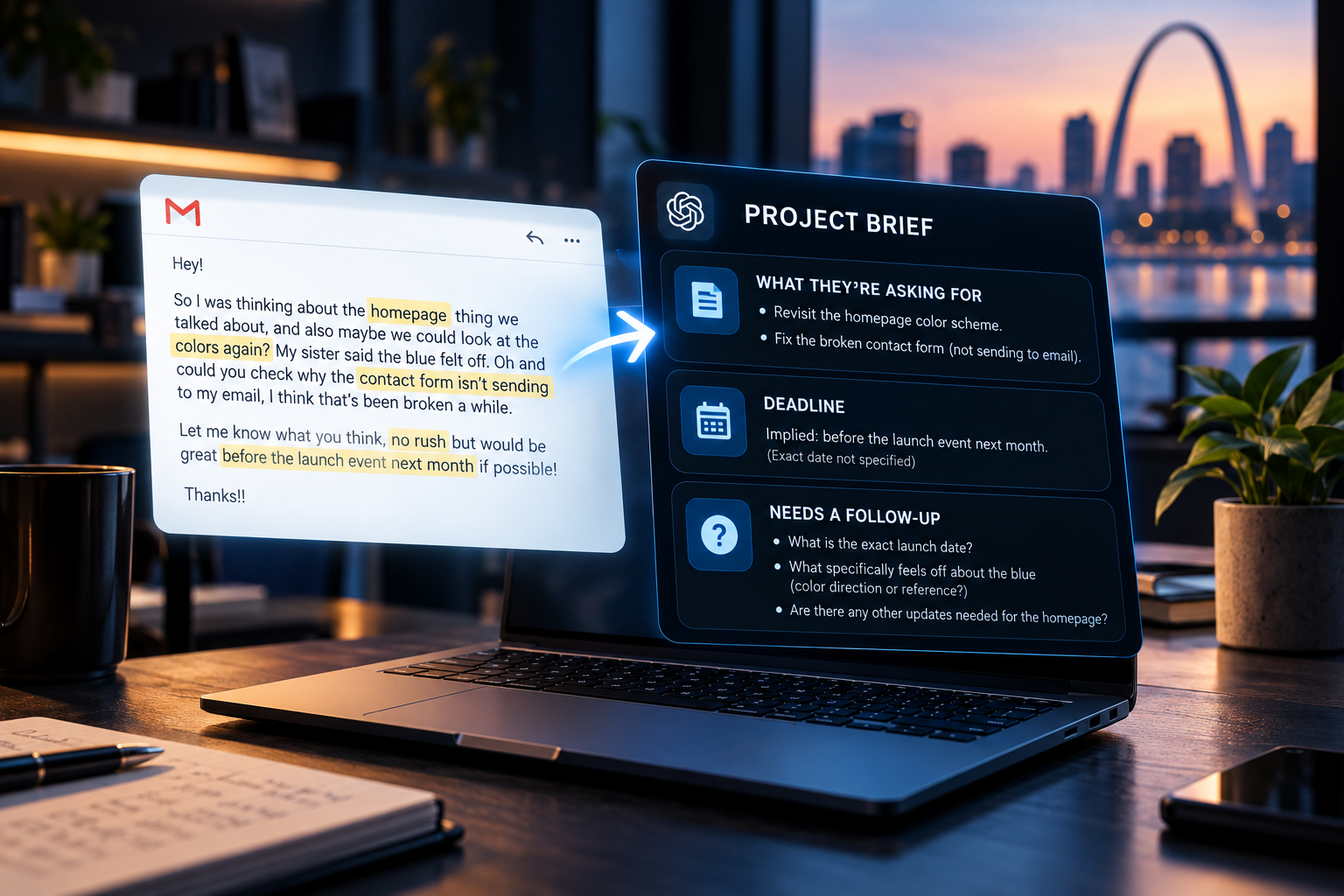
PromptingVague one-liners. Hopes the first answer is usable.
PromptingStructured requests — context, format, and constraints built in.
Trust in outputEither blind trust or total distrust — no in-between.
Trust in outputKnows exactly what needs a human check and what doesn't.
Time impactNet time lost re-doing what the AI got wrong.
Time impactNet time saved, and can actually name the number.
Where it gets usedLow-stakes busywork only — anything that matters is still done by hand "to be safe."
Where it gets usedReal, high-stakes work — because they know how to verify it.
Where the skill livesIn one person's head. If they leave, it leaves with them.
Where the skill livesDocumented and shared — the whole team gets better, not just one person.
Why the gap is widening, not closing
Left alone, this doesn't self-correct — it compounds. The World Economic Forum estimates 59% of the global workforce will need reskilling or upskilling by 2030, and roughly 11% of those people are unlikely to receive it on current trends. Meanwhile only about a third of workers have received any employer-provided AI training in the past six months, despite the majority already using it weekly. The tools get better every quarter. The training gap doesn't shrink to match — it just becomes a wider gap between the same two people.
63%Of employers name skill gaps as the single biggest barrier to business transformation — ahead of budget, technology, or regulation (World Economic Forum, 2025).
86% vs 24%Individual contributors using AI at work, versus the share who strongly agree their organization prepared them to use it well (Skillsoft, 2026).
1 in 3Workers who've received any employer-provided AI training in the past six months, despite most already using AI regularly (The Conference Board, 2026).
67% vs 32%How much of AI outcome variance is explained by culture and manager support versus individual aptitude (Microsoft Work Trend Index, 2026).
59%Of the global workforce will need reskilling or upskilling by 2030 — roughly 120 million people (World Economic Forum, 2025).
36%Of organizations mandate any form of AI awareness training at all (IDC).
Figures are drawn from published 2025–2026 research (World Economic Forum, Microsoft, Skillsoft, The Conference Board, IDC, and related studies), cited directionally to show the shape of the trend rather than a guarantee for any specific organization.
AI doesn't replace strategy. It amplifies it. The organizations that win will be the ones who invest in both.
Signs your team already has this gap
- One person is quietly doing everyone's "AI work" because nobody else trusts their own output enough to rely on it.
- Your team's entire AI training was a 20-minute demo, months ago, never repeated and never measured.
- People use AI for low-stakes busywork only — anything that actually matters still gets done the old way, "to be safe."
- Nobody can name a single workflow that measurably changed because of AI. Usage is up. Outcomes are the same.
How you actually close it
- Treat AI literacy like onboarding, not an announcement — ongoing and role-specific, not a single company-wide webinar.
- Document the prompts and workflows that actually work, and share them. Capability that lives in one person's head isn't organizational capability.
- Measure time saved and errors avoided per workflow — not logins, not licenses, not "usage."
- Give people explicit permission to use AI on real work, with a clear, written line for what still always needs a human sign-off.
The bottom line
Everyone in your organization already has access to AI. That was never going to be the differentiator — it took one procurement decision and a company-wide email. The differentiator is whether anyone built the capability layer underneath it: training that's actually happened, workflows that actually changed, and a way to tell whether any of it worked. Right now, most companies have the first thing and not the second. That's the whole gap, and it's closable — but only on purpose.
Want to know exactly where your team's skill gap is widest?
Spark AI Strategy runs the diagnostic and builds the training plan from there.
Take the AI Adoption Scorecard