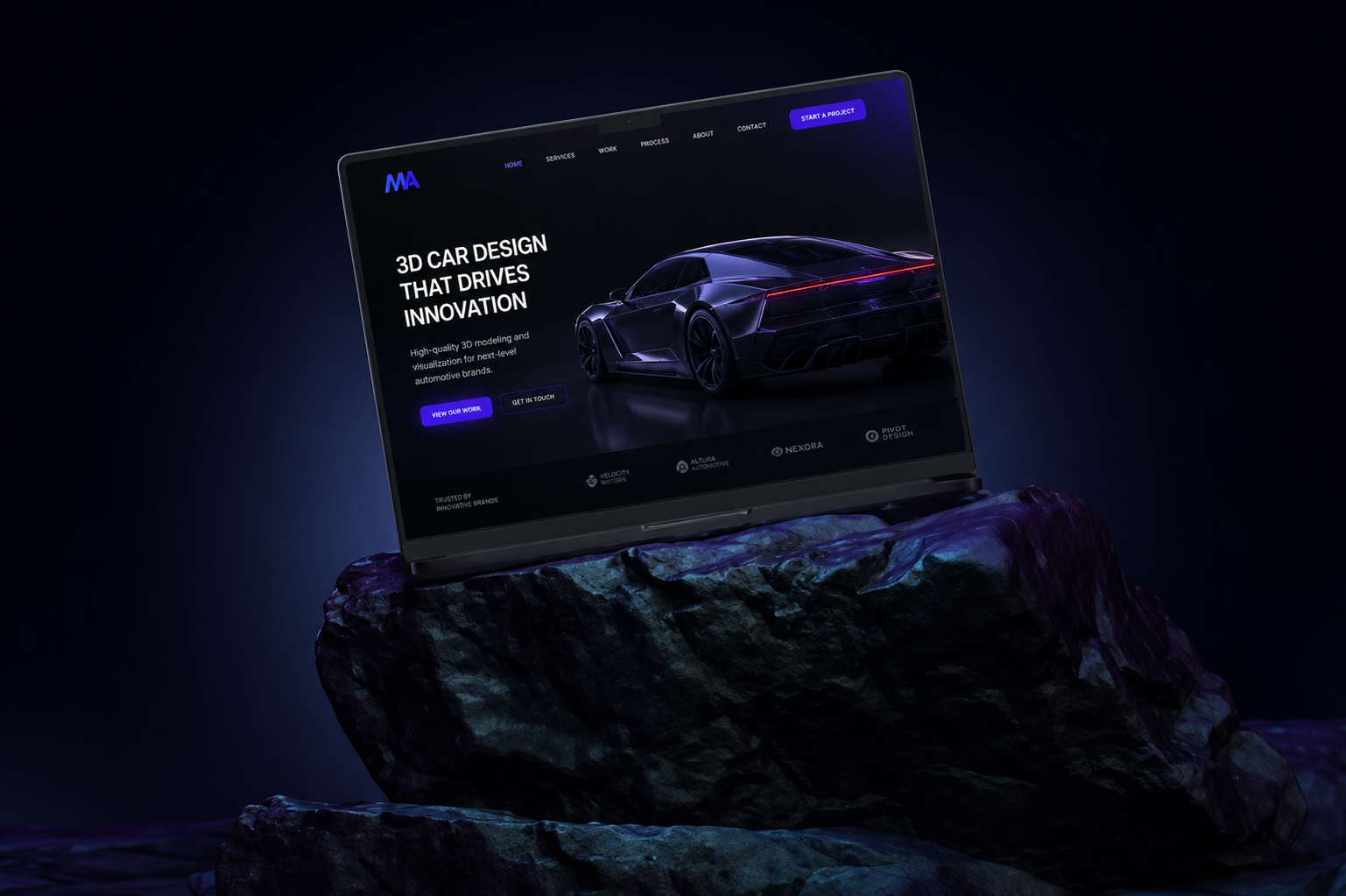
Your hero section has about three seconds to make its case. Most companies spend those three seconds on a static image, a stock photo, or a flat gradient with some text on top. That's not a design choice — it's a missed opportunity.
I've spent close to thirty years building digital products, starting in architecture, where the first thing you learn is that people respond to space and motion before they respond to words. A website is no different. The hero section is your building's entrance. A 3D animated hero doesn't just look modern. It changes how long people stay, how much they trust you, and how much of your story actually gets through.
The problem with static heroes
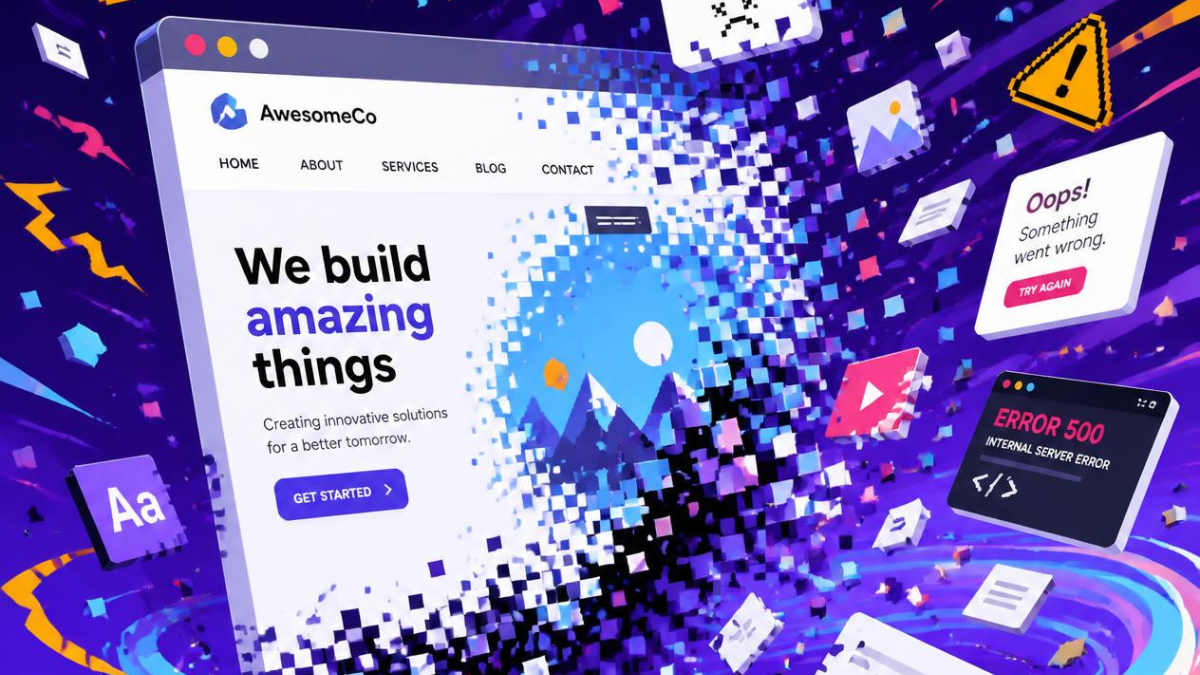
A flat hero section asks the visitor to do all the work. They have to read the headline, interpret the image, and decide if you're credible — all before they've scrolled an inch. Most won't finish that sequence. They'll bounce.
A 3D animated hero does the opposite. Motion draws the eye before the visitor consciously decides to look. Depth signals production value — it tells a visitor, instantly and without a word, that this company invests in how it presents itself. That's brand credibility, delivered in the first second, before your copy even has a chance to work.
What 3D animation actually earns you
- Longer time on page. Motion holds attention longer than a static image — every heat-map study we've run on client sites confirms it.
- Higher perceived value. A product or service rendered in 3D, rotating or responding to scroll, reads as more sophisticated than the same thing in a flat photo.
- A clearer story. 3D lets you show a process, a product, or a transformation in motion — the exact thing a paragraph of copy struggles to do.
- Differentiation. Almost none of your competitors are doing this well. That gap is still wide open.
See It In Motion
Not a mockup — this is running live on this page
Two ways 3D changes a hero: a rendered product turning in space, and depth that responds to your cursor.
yourbrand.com
Auto-rotating 3D watchPure CSS · zero video weight
yourbrand.com
background
midground
YOUR CTA
move your cursor here
Pointer-driven depthResponds to the visitor, not a script
By the numbers
Most published research measures hero video, not 3D animation specifically — the two categories haven't been studied as separately as they should be. But the underlying mechanic is the same: motion in the hero holds attention and builds trust that static images don't. Here's what the broader research on motion in hero sections shows.
Up to 86%Potential lift in landing page conversion when the hero features video, per industry benchmark data (VWO, Saleslion).
50msHow long it takes a visitor to form an opinion of your site — before they've read a single word.
38%Share of marketers who say video is the single element with the biggest positive impact on conversion (VWO).
~95%Message retention for content delivered through video versus text alone, per industry-cited research.
34%Average conversion lift reported by marketers after adding video to a campaign (Aberdeen Group).
-7%Average conversion loss per additional second of load time — why lightweight, CSS-driven 3D matters as much as the concept itself.
Figures are industry-reported benchmarks for hero video broadly, cited here directionally — not guarantees, and not specific to 3D animation. We include the load-time figure deliberately: it's the tradeoff that makes lean, engineered motion the better investment over a heavy video file.
Motion isn't decoration. It's a second communication channel — one most companies leave completely unused.
More reasons it's worth the investment
- No reshoot costs. Update the 3D asset for a new campaign or a product refresh without booking a new production day.
- Lighter than video. A well-built CSS or WebGL animation can run a fraction of the file size of a comparable video loop — you get the engagement lift without the load-time tax in the stats above.
- Cross-channel reuse. The same 3D asset can power your website hero, ad creative, app store preview, and pitch deck — one build, many placements.
- A longer runway before it looks dated. Trend-driven stock photography ages fast. A well-designed 3D piece tied to your product, not a design fad, holds up longer.
Where this goes wrong
3D animation fails when it's added for its own sake. A hero that spins for the sake of spinning slows your load time, distracts from the message, and irritates a visitor on mobile data. The animation has to serve the story — the product, the transformation, the outcome — or it's just noise with better production values.
The other failure point is technical: heavy 3D assets built without performance in mind will tank your load speed, and load speed still decides whether anyone sees the animation at all. Done right, this is engineering work as much as it's design work.
The bottom line
If your hero section is a static image with a headline on top, you're leaving credibility, engagement, and story on the table. 3D animation, built with intent and built to load fast, is one of the highest-leverage upgrades you can make to the first three seconds of your website.
Want to see what this looks like on your site?
MindActive builds custom 3D hero experiences — designed for the story, engineered for speed.
Book a Call