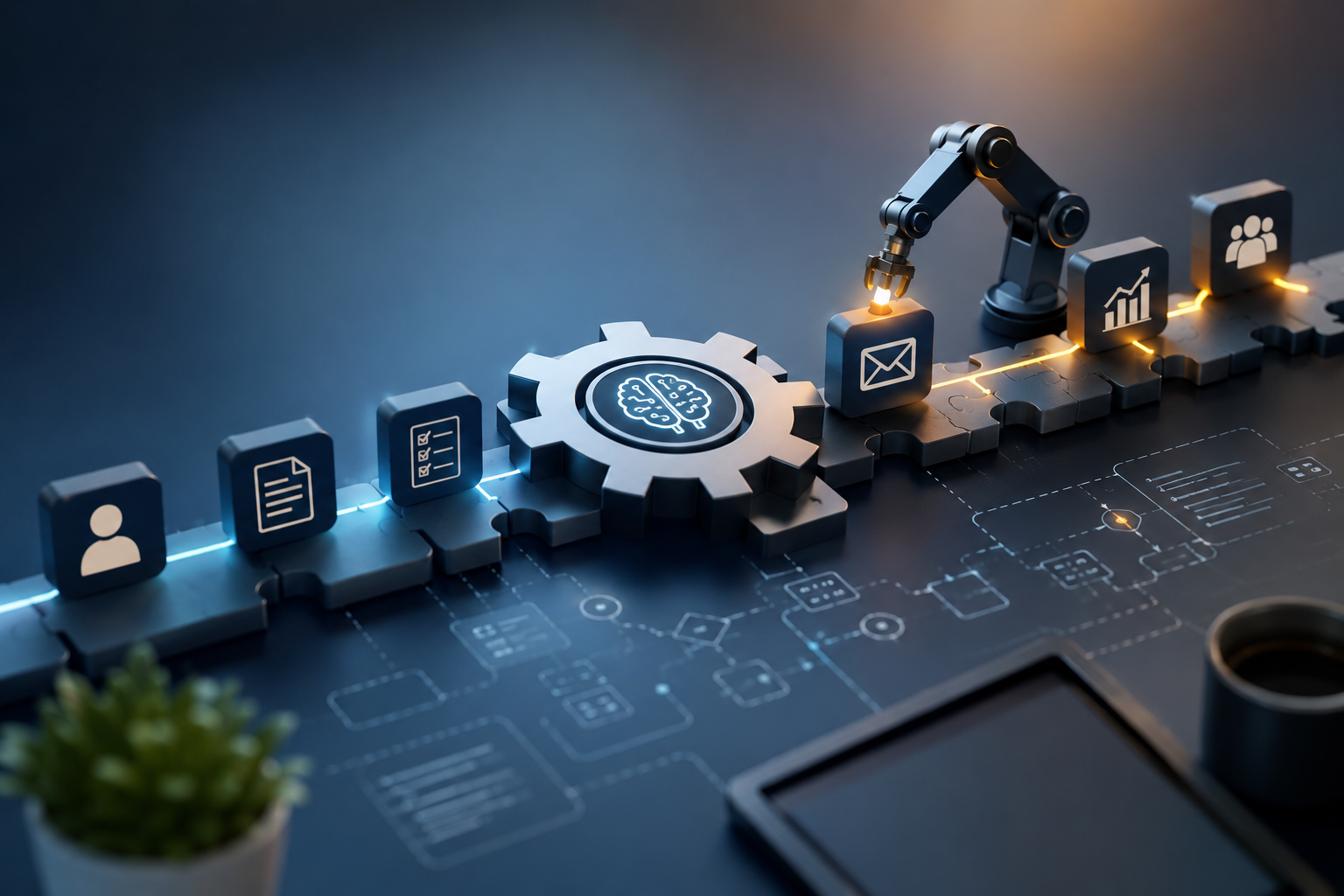
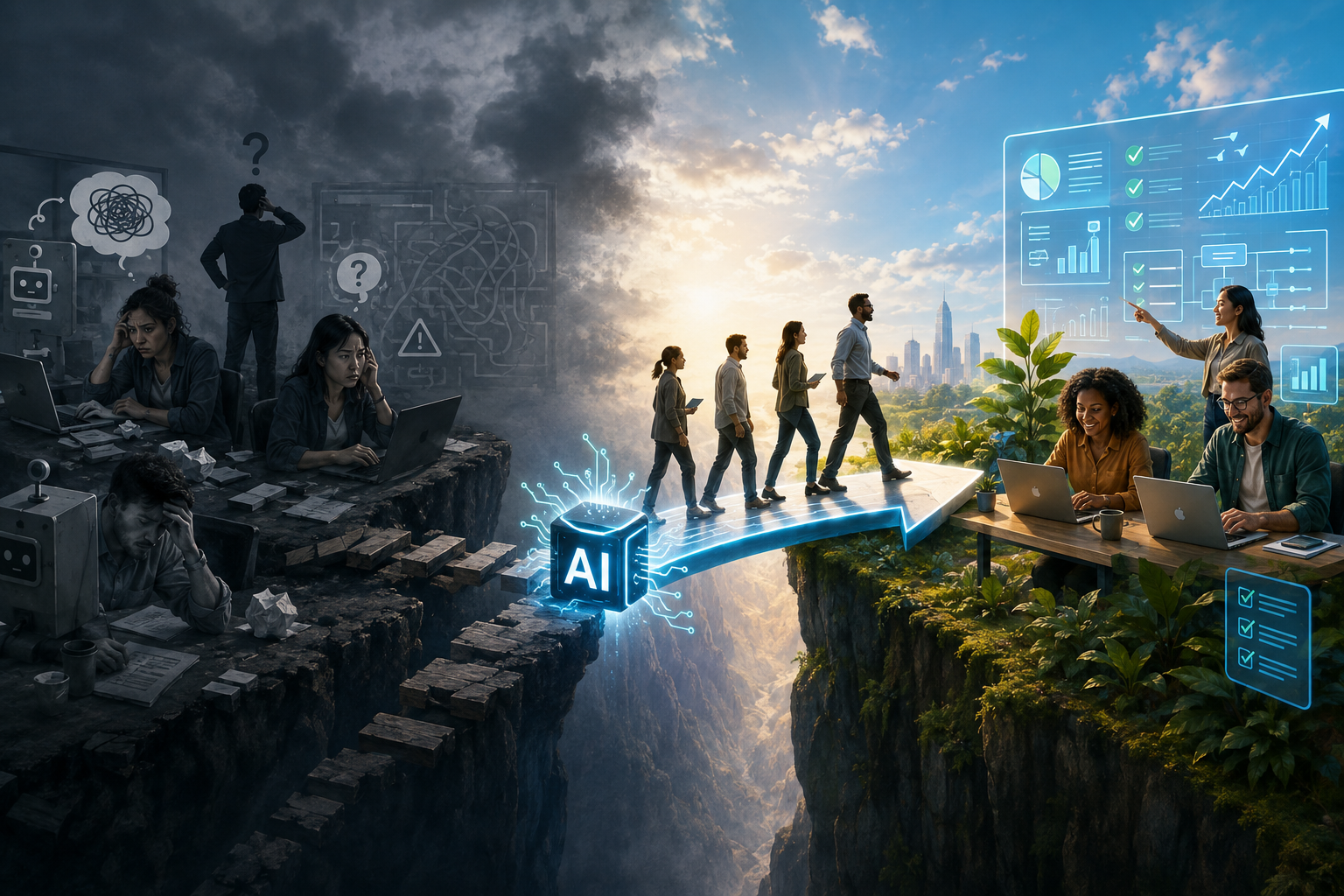
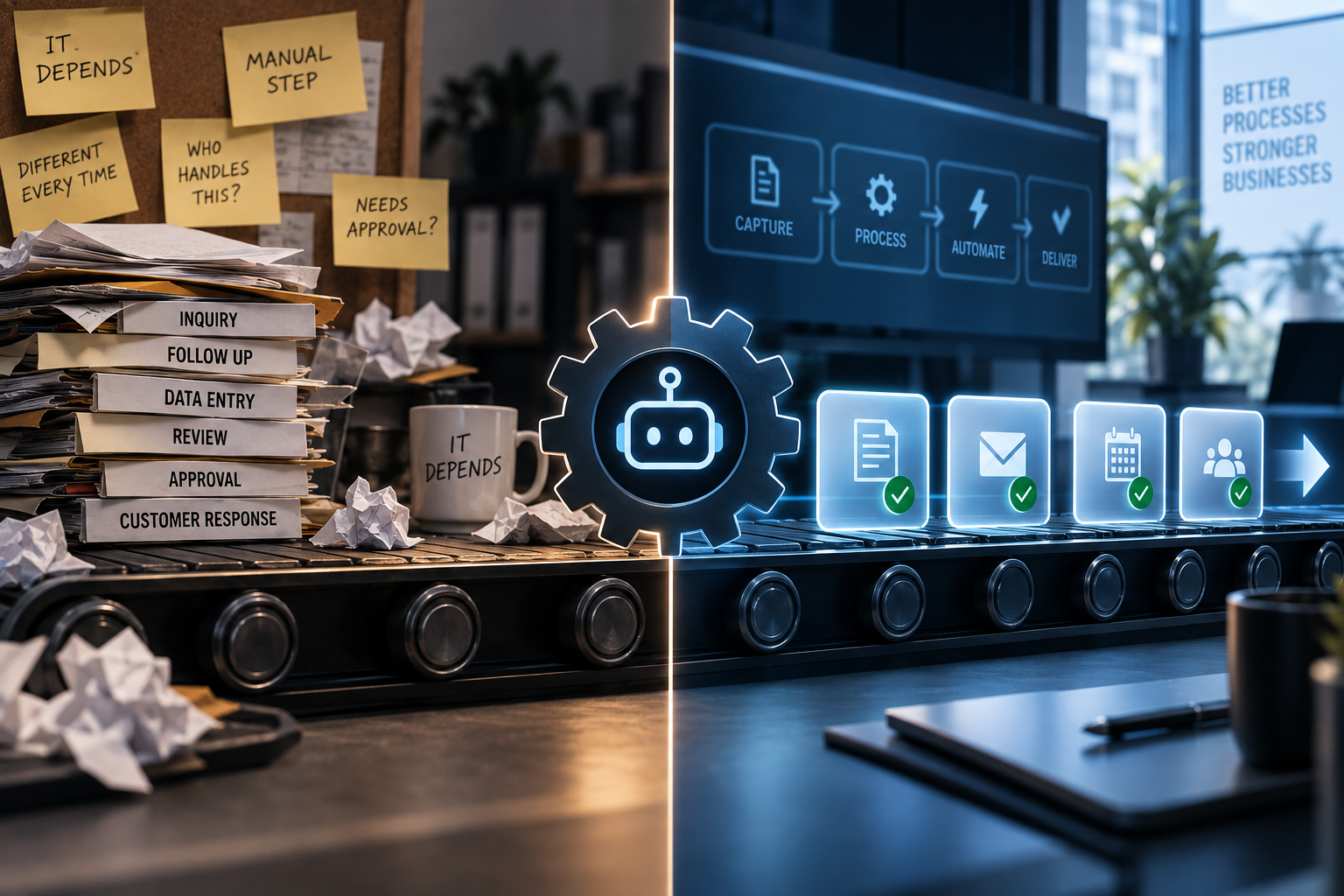
"AI or human" is the wrong question, and every business still asking it is already behind. The businesses actually winning right now aren't choosing a side. They're building teams where AI and people each do the part they're better at — and they're doing it on purpose, with rules, not by accident.
I've watched three decades of technology shifts hit business the same way: the tool arrives faster than the judgment about how to use it. AI is no different. The gap isn't access to the technology anymore — 91% of businesses already use it in some form. The gap is what happens after that: who's accountable, who's trained, and who's allowed to say no to a bad output.
The false binary
Replace the team with AI, and you get speed without judgment. Keep the team exactly as it was and bolt AI on top, and you get a slower team that's now also reviewing AI's homework. Neither is a strategy. Both are what happens when a company adopts a tool without deciding what the tool is actually for.
The data backs this up in an uncomfortable way. Experienced developers using AI coding tools took 19% longer to finish tasks — while believing they'd been 20% faster. That gap between felt speed and actual speed is exactly where "AI vs. human" thinking breaks down. The tool wasn't the problem. The absence of a plan for using it was.
What's actually happening inside smart companies
The companies pulling ahead aren't the ones with the most AI tools. They're the ones who organized people and AI into a system on purpose — clear ownership, clear escalation, clear rules for when a human has to sign off. Researchers now call these "Frontier Firms," and the employee experience gap is not subtle: 71% of employees at these companies report thriving, versus 37% at typical organizations.
Adoption is also not evenly spread. Mid-sized companies — the 100 to 2,000 employee range, past the point of ad-hoc experimentation but small enough to move fast — are leading, with over 60% now running AI in production and reporting 26–55% productivity gains. That's not a coincidence. That's a company small enough to still have one throat to choke and large enough to actually run a pilot.
Where AI wins
Where people still win
Speed at scaleProcessing volume no human team could match, without fatigue.
Judgment under ambiguityKnowing what to do when the situation doesn't match any pattern in the data.
First draftsGetting a document, a summary, or code from blank page to 70% done in minutes.
Owning the outcomeSomeone accountable when the decision is wrong — a role AI structurally can't fill.
Pattern detectionSpotting a signal buried in a dataset too large for a person to read manually.
Reading the roomSensing what a client, a board, or a team actually needs — not just what they said.
Always-on availabilityNo fatigue, no time zone, no bad day affecting the tenth task the way it affected the first.
Knowing when the rule shouldn't applyThe exception that a rigid system will follow straight into a mistake.
By the numbers
The headline adoption numbers look great. The numbers underneath them are the ones that actually separate the companies getting a return from the ones just spending money.
91%Of businesses now use AI in at least one capacity — up from 55% just two years earlier (McKinsey / industry benchmark data, 2026).
6%Share of companies McKinsey classifies as genuine "AI high performers," despite 88% regularly using AI (McKinsey State of AI, 2025–26).
71%Employees reporting they're thriving at companies that deliberately organize people and AI together — versus 37% globally.
41%Workers who've received AI output from a colleague that was unusable and needed rework — each incident costing roughly 2 hours and $186 (HBR-cited research, 2025–26).
$3.70Average value generated per $1 invested in AI-supported workflows — concentrated in companies that actually manage the rollout.
19%More time it took experienced developers to complete tasks using AI tools — despite believing they were 20% faster (METR, 2025).
Figures are drawn from published 2025–2026 industry and academic research (McKinsey, HBR, METR, and related studies), cited here directionally to show the shape of the trend — not as a guarantee of results for any specific business.
AI doesn't replace strategy. It amplifies it. The organizations that win will be the ones who invest in both.
Where companies get this wrong
- They treat adoption as the finish line. Buying the tool and measuring nothing after is how a company ends up in the 88%-adopted, 6%-high-performing gap.
- They skip the training and go straight to the mandate. AI capability without AI literacy is how "workslop" happens — confident, wrong output that costs more time to fix than it saved.
- They never decide who's accountable. If no one owns the AI-assisted decision, no one catches it when it's wrong.
- They measure adoption instead of outcomes. Usage numbers go up. Nobody checks whether the work actually got better.
What smart businesses are actually doing
They're not asking "AI or human." They're asking a more specific question, department by department: what should the human always own, what should AI always draft, and where's the line neither one crosses without the other checking their work.
That's a leadership decision before it's a technology decision — governance, training, and behavior change, in that order. Skip straight to the tools and you get exactly what the data shows: a company that's fully adopted and barely ahead of where it started.
Not sure where your team sits on that line?
Spark AI Strategy builds the roadmap — governance first, tools second.
Book an AI Strategy Call